Offer
Provide additional details about the offer you're running.
FLASHSALE


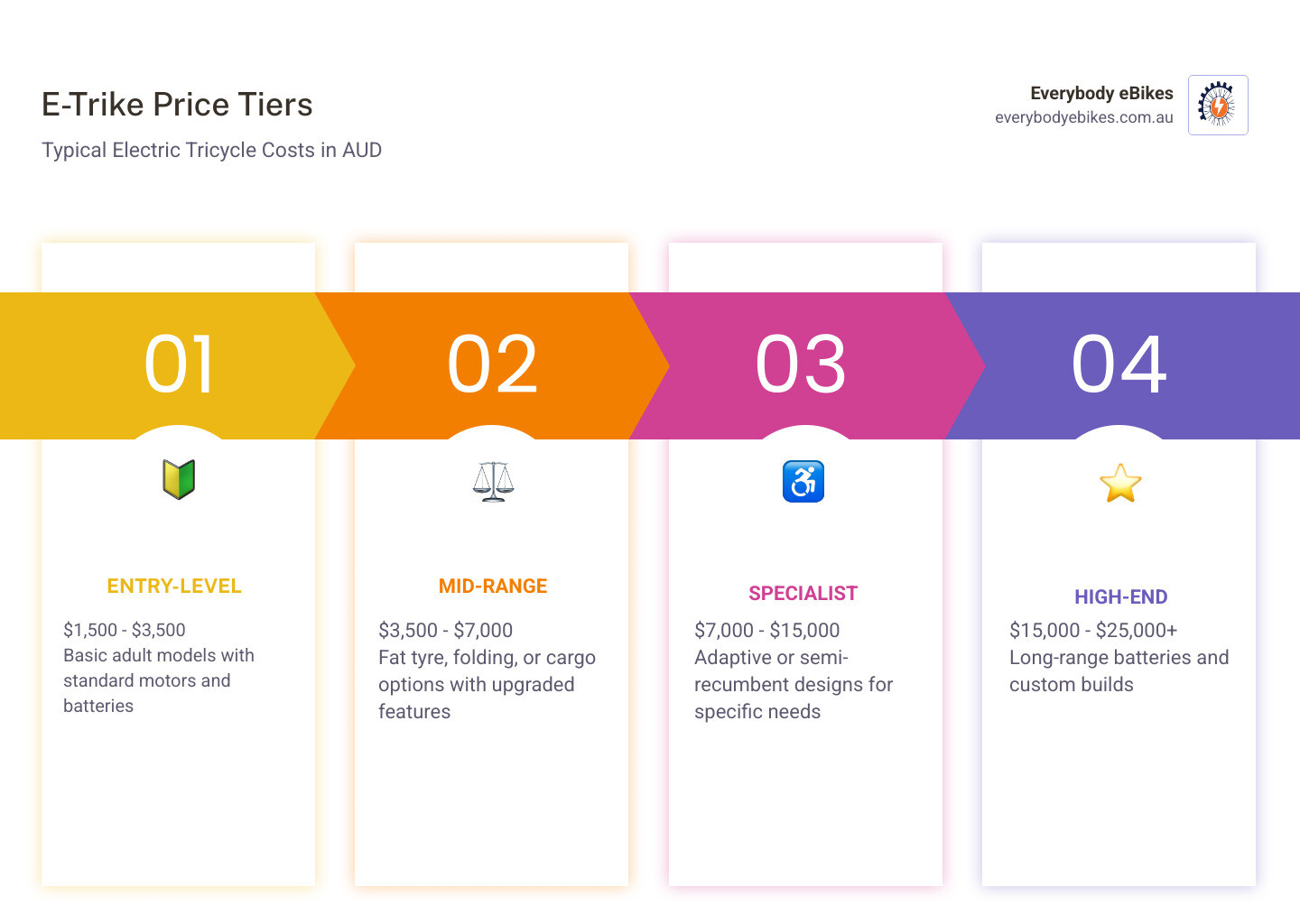
Electric tricycle cost in Australia typically falls within the following ranges, depending on the type and features:
| E-Trike Type | Typical Price Range (AUD) |
|---|---|
| Entry-level / basic adult e-trike | $1,500 - $3,500 |
| Mid-range (fat tyre, folding, cargo) | $3,500 - $7,000 |
| Specialist / adaptive / semi-recumbent | $7,000 - $15,000 |
| High-end / long-range / custom builds | $15,000 - $25,000+ |
Prices vary based on motor power, battery capacity, frame design, and the level of specialist support included.
Buying an e-trike is exciting, but the price tag can feel confusing at first glance. A quick search will show you figures ranging from under $2,000 to well over $20,000, and it is not always obvious what you are actually paying for.
The difference between a $2,500 model and a $10,000 one is not just about speed or looks. It comes down to motor quality, battery lifespan, frame adaptability, and the level of ongoing support you receive after purchase.
For many riders, especially those returning to cycling after a gap or managing a health condition, getting the right trike at the right price is genuinely life-changing. One customer we heard from described their e-trike as restoring independence they thought they had lost for good.
That is exactly why understanding the real cost, not just the sticker price, matters so much before you commit.
I'm Andrea Herklots, owner-operator of EveryBody eBikes, and helping Australians navigate electric tricycle cost is something I do every day across Brisbane, regional Queensland, and beyond. In the sections below, I will walk you through everything from purchase price to long-term savings, so you can make a confident, informed decision.
Electric tricycle cost helpful reading:
A quality e-trike generally ranges from $2,500 to $7,000 depending on the motor system and battery capacity. High end models with specialised adaptations or long range batteries can exceed $10,000.
When we look at the Australian market, quality entry-level e-bikes and basic trikes typically start from $1,500 to $2,500. For example, a compact option like the ezi-Step 20" Folding eBike starts at $1,400 (as of this writing). However, as we move into three wheels, the engineering requirements for stability and cargo capacity often push the price higher.
Mid-range models that offer more versatility, such as the Trojan Family Fat Tyre Electric Tricycle, provide significant value. This specific model is currently on sale for $6,495, down from its regular price of $7,950. These types of trikes are perfect for families or those needing to traverse softer terrain like gravel or grass.
For seniors or those requiring specific mobility support, the typical range for a reliable sit-down or semi-recumbent trike is $3,500 to $25,000. The higher end of this scale often includes sophisticated mid-drive systems like the Bosch Smart System. These systems are prized for their reliability, over-the-air updates, and seamless app integration, ensuring your investment stays current with the latest technology.
Understanding the full financial commitment involves looking at the purchase price, maintenance, and long term savings. This section breaks down the most common queries regarding e-trike investments.
The primary drivers of price are the motor brand, battery watt hours, and frame material. Premium systems offer higher reliability and better app integration which increases the upfront investment.
Beyond the electrical components, the complexity of the frame plays a massive role. A folding frame requires precision hinges, while a semi-recumbent design needs specialised seating and ergonomic geometry to reduce joint strain. High-quality hydraulic brakes are another essential factor; they provide significantly more stopping power with less hand effort, which is a must for heavier three-wheeled vehicles.
We also consider the value of expert fitting. At EveryBody eBikes, we don't just sell a box; we ensure the trike is tailored to your height, reach, and mobility needs. This personalised approach prevents the "hidden cost" of buying a trike that sits unused in the garage because it is uncomfortable. You can learn more about this in our Shop Smart Guide.
Ongoing costs are remarkably low, typically involving just a few cents per charge and annual professional servicing. Budgeting for a battery replacement every five to eight years is the largest long term expense.
Research shows that charging an e-trike is incredibly economical. For instance, a full charge for a standard battery might cost around 12 cents. If you travel 100 kilometres, you might spend only about $1 in electricity. This makes the electric tricycle cost per kilometre approximately 0.3 cents, which is a fraction of the cost of any fossil-fuel vehicle.
Maintenance is the other key factor. We recommend regular servicing to keep your ride safe. Our servicing packages include a Checkup for $100, a Standard service for $169, or a Premium service for $299. Regular checks on tyre pressure, chain lubrication, and brake pad wear will extend the life of your components.
For more on planning your e-mobility finances, see our guide on how to budget for an e-bike.

In Australia, car ownership is a major drain on household budgets. A second car can cost $8,500–$13,000 per year once you factor in fuel, insurance, registration, servicing, and depreciation. By contrast, a compliant e‑trike is treated as a bicycle: no licence, no registration, and no expensive insurance.
Using a trike for local errands, school runs, or short commutes not only saves money, but also reduces your carbon footprint. While a typical passenger vehicle emits several tonnes of CO₂ annually, an e‑trike produces zero tailpipe emissions, making it a win for both your wallet and the planet.
Buyers should account for shipping, professional assembly, and essential safety gear like helmets and locks. These extras typically add $300 to $800 to the total purchase price.
Most high-quality trikes are shipped in large crates and require significant technical skill to assemble correctly. We strongly advise against "DIY" assembly for three-wheelers, as steering alignment and brake synchronisation are critical for safety. Professional assembly ensures that every bolt is torqued correctly and the electronics are updated.
You should also budget for accessories to enhance your experience. A high-quality helmet is a legal requirement in Australia, and a robust lock is essential to protect your investment. Other popular additions include mirrors for better visibility and specialised baskets for grocery runs.
The best value is found in models that balance durable components with versatile features like folding frames or fat tyres. Selecting a trike from Everybody eBikes ensures long term support and a personalised fit for every body.
Value is not just about the lowest price; it is about the lowest "cost per use." A cheaper trike that breaks down frequently or is uncomfortable to ride ends up being more expensive in the long run. Models like the Trojan Family Fat Tyre Electric Tricycle offer great versatility for Australian conditions.
For those with specific needs, we offer adaptive models like the Rehatri range. While optional modifications and postural supports come at an extra cost, they allow individuals with disabilities to experience the joy of movement. We also have exciting offers like the Benno 46er and RemiDemi XL, which currently include a FREE Passenger Pack for a limited time.
Check out our list of the Top 5 Trikes to see which model might suit your lifestyle.
Yes, typically. The electric tricycle cost is higher because trikes require more materials for the frame, an additional wheel, more complex braking systems (often with three discs), and a differential on the rear axle to allow for safe turning. The added stability and cargo capacity justify the higher engineering costs.
Many of our clients successfully use NDIS funding to cover the cost of their e-trike. Since trikes provide essential mobility and exercise for individuals with balance or physical challenges, they are often seen as "reasonable and necessary" support. We recommend speaking with your occupational therapist about an assessment. Some specialised models, like the Huka Orthros Tandem Tricycle, have pricing listed ex-GST for this reason.
A quality lithium battery from a brand like Samsung or Bosch will typically last between 500 and 1,000 full charge cycles. For the average rider, this translates to five to eight years of use. To maximise your battery's life, avoid leaving it completely empty for long periods and store it in a cool, dry place.
No. As long as the e-trike meets Australian regulations (such as having a motor limited to 250W for pedal-assist and a speed cut-off of 25km/h), it is legally treated as a bicycle. This makes it an excellent option for those who can no longer drive or prefer not to.
Investing in an electric tricycle is a significant decision, but when you look at the total electric tricycle cost, the value becomes clear. From the massive savings compared to car ownership to the priceless benefits of independence and health, an e-trike is more than just a vehicle; it is a gateway to a more active life.
At EveryBody eBikes, we are dedicated to finding the perfect fit for your needs and budget across our locations in Queensland, Victoria, New South Wales, and New Zealand. Whether you are looking for a rugged fat tyre model or a comfortable semi-recumbent trike, we are here to support your journey.
Life is a Journey, Ride it!